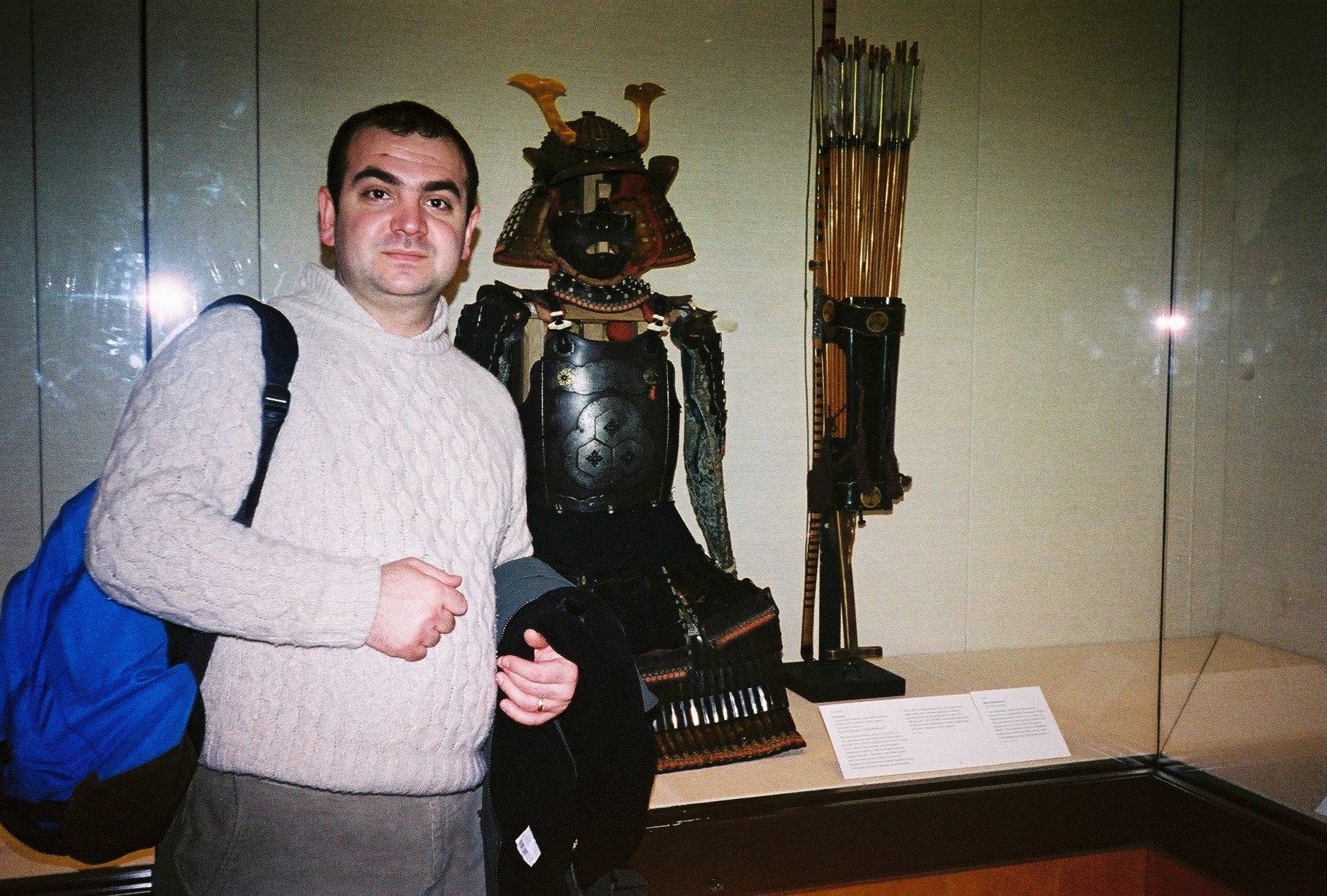
There is a photograph of me from February 2005, taken in a museum in Madrid whose name I would have to find the ticket stub to swear to. I am in a cream wool sweater with a blue backpack over one shoulder, and beside me, behind glass, stands a full suit of samurai armor: black lacquered plates bound with silk cord, a helmet crowned in gilt, and next to it a stand of arrows, fletched and patient, as if the owner had stepped out and meant to come back.
He did not come back. That is the first thing every armor gallery teaches, though it is written on no placard. The armor survived four centuries. The man inside it survived his allotted handful of decades, and the case has been empty ever since. A museum of armor is a museum of absence — the best-protected absence money could buy.
I want to be fair to the armor, because it is a masterpiece. Every plate is angled to shed a blade. The cords are silk because silk holds a knot under strain. The helmet's crest announced the wearer to allies across a burning field. Nothing about it is decoration; it is a complete answer to a specific question — how do I keep everything out? — and it worked. That is the problem. It worked on everything. The arrow could not reach the man, and neither, through all that lacquer, could very much else.
I spent more than thirty years in hospitality, and I met the armored ones in every lobby on four continents. They are not hard to recognize. The breakfast taken with one hand on the phone. The handshake calibrated to concede nothing. The schedule built so tightly that no unplanned conversation can land. Wealth is often part of the armor, but it is not the material; I have seen the same plating on people who had nothing but their vigilance. The material is control, and the craftsmanship can be extraordinary. Some of these guests had been forging their suit since childhood, plate by plate, and it fit perfectly. They were the safest people in the building and, as far as I could ever observe, among the loneliest.
The research on loneliness and isolation — the large reviews that associate it with mortality risk on the scale of the risks we print warnings about — circles this figure without ever quite drawing him. I wrote about him elsewhere in this edition, the man cinema understands better than the conference circuit does: the one whose intervention had to be designed by people who studied him first, because comfort slides off lacquer, and no amenity ever forged is sharp enough to get through. The deepest truth about armor is that it cannot be argued off. The man inside has heard every argument. He built the suit because of some of them.
What does take armor off? The galleries answer that too, quietly. Armor comes off in two places: in defeat, and at home. The first is the one nobody chooses and some people are unknowingly traveling toward. The second is the interesting one. Home — the place safe enough that the weight can come down, the helmet can sit on a shelf, and the shoulders can remember their natural height. Most of the armored guests I met had money for any room on earth and no place that qualified.
This is where my practice makes its small, specific claim, and I will keep it in the register of a hypothesis, because that is the house rule. A week in a high valley does not melt anyone. But a place that asks something real of the body — cold water, a path with gradient, mornings that start without an audience — is difficult to attend in full plate. You cannot walk a steep pasture while conceding nothing. The landscape does not negotiate, which paradoxically is what makes it trustworthy; it has no angle, so vigilance has nothing to grip. I have watched shoulders change height over six days. I am careful about what I claim that means.
And because this magazine insists that a trip is a data point, here is the question I would put to the instruments: if armor has a signature, where would it show? In the sleep of a person who is braced — in how long the body takes, on night one and night five, to accept that no blow is coming? In a morning pulse that stands down across a week? I do not know yet, not with the confidence of a trend. One week is one test, and one test is noise. But it is a question a designed week can ask on purpose, with a baseline before and a re-test after — which is more than the lobby ever asked.
The armor in the photograph is still in its case, and it should be; it belongs to history now, and history is the right owner for it. The man it was built around was never meant to stay inside. That is the whole essay, and it took me twenty years and one old photograph to read it: protection is a tool, not an address. The suit is for the battle. The shelf is for the suit. The valley, the table, the people who know your name when you return — that is for the man.
Ahmet Can Yeşildağ spent more than thirty years in hospitality, across North America, the Caribbean, Europe, Asia and the Middle East & North Africa, before founding Orophile. He writes here on the design of restorative and longevity travel.
Weighing a trip like this? Start with a Free Introduction · 20 minutes. No obligation. → Or start with Eight Questions Before You Book.