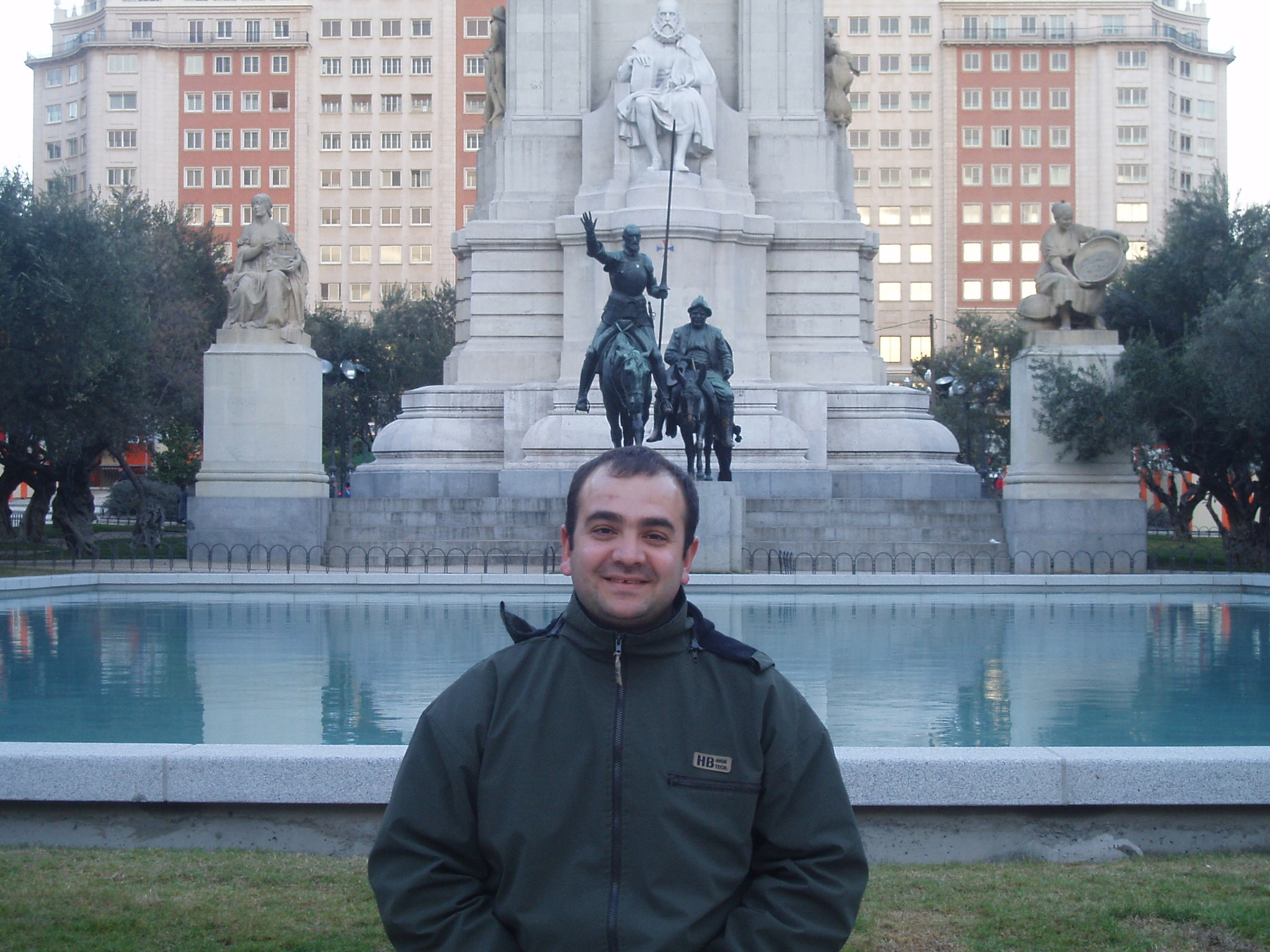
In February 2005 I stood in Plaza de España in Madrid with a film camera and a winter coat, and someone photographed me in front of the Cervantes monument. The arrangement of that monument is the whole essay, though I did not see it then. Cervantes sits high in carved stone, still, finished, holding his book. Below him and ahead of him, in bronze, Don Quixote rides Rocinante with his lance up, and Sancho Panza follows on his donkey. The writer is seated. The characters are moving. Whatever you make with conviction rides out ahead of you and keeps going after you stop.
Here is the detail the postcard version forgets: Don Quixote is not young. Cervantes is precise about it — a country gentleman nearing fifty, which in 1605 was not the middle of anything. The village had him catalogued: a thin hidalgo with a library habit, a housekeeper, a niece, and nothing left on the calendar but more of the same. His story, as far as anyone around him was concerned, was complete. The neighbors had already written the ending; it was quiet, respectable, and short.
He declined it. He renamed himself, renamed his tired horse, polished a great-grandfather's rusted armor, and rode out — late, ridiculous, and utterly alive. The book calls it madness, and the neighbors call it madness, and the priest and the barber burn his library to cure him of it. But look at what the so-called madness actually contained, because the inventory is instructive: an appetite for the road. A mission he could narrate. Motion, daily and physical, in all weathers. And — by the second expedition — a companion. He talks Sancho into the saddle with a promise of an island, but what he actually gives him, chapter after chapter, is conversation: two people who become unrecognizable apart by the end of a thousand pages.
Courage and connection. I keep arriving at the same two ingredients from every direction — the films reach them, and the long studies of adult life keep associating them with the years that stay worth living. Quixote, fictional, elderly, and frequently face-down in the dust of La Mancha, holds both like a torch. The man who was supposed to be finished at fifty becomes the most alive person in the book, and the people who stayed safely home are remembered only for trying to stop him.
I want to be honest about the dust, because this is not a brochure for delusion. The road beats him up. He mistakes windmills for giants, inns for castles, and a barber's basin for a helmet, and he pays for every error in bruises. Cervantes is not arguing that an old man should gallop at machinery. The windmill scene is a caution about choosing your giants badly — not an argument against having giants at all. The tragedy in the book is not the beatings. The tragedy is the ending: brought home, defeated, Alonso Quijano renounces the whole enterprise, recovers his sensible name, apologizes for his adventures — and dies. Cured and dead in the same chapter. The neighbors finally got their quiet ending, and it lasted a page. Cervantes buried his joke where only careful readers would find it: the madness was load-bearing.
More than thirty years of hospitality experience showed me both endings, over and over. I met the riders — the ones who arrived with a project, a question, a route they had argued about at breakfast — and I met the ones who had renounced: still traveling, technically, but with the appetite filed away, the itinerary outsourced, nothing at stake anywhere on the calendar. The difference between them was never age. I have seen the renunciation in people of forty and the lance still up at eighty. The body, as far as I could ever observe, keeps honest minutes of which mode it is living in.
What does a designed week take from this? A smaller, saner sally — that is the shape I keep coming back to. A named giant: one real hypothesis about your own tiredness, chosen before departure the way Quixote chose his quests, but with better intelligence. A Sancho: because the research and the novel agree that nobody changes alone, and the conversation on the path does work the path cannot do by itself. And a return that is not a renunciation: you come home with something to retell and the next expedition already forming — a re-test on the calendar, a reason the road stays open. A baseline before, a measurement after, a story in between. Cervantes, who wrote his masterpiece in his late fifties after prison, poverty, and a ruined hand, would have recognized the design. He was the proof of it.
In the photograph I am standing between them — below the stone writer, behind the bronze riders — on the edge of thirty and not yet aware that the question of my working life was carved over my head. Which figure are you sitting for? The village will always offer to finish your story early; it means well, and it is wrong. The monument has the answer in its geometry. The stillness is for the record. The riding is for the man.
Ahmet Can Yeşildağ spent more than thirty years in hospitality, across North America, the Caribbean, Europe, Asia and the Middle East & North Africa, before founding Orophile. He writes here on the design of restorative and longevity travel.
Weighing a trip like this? Start with a Free Introduction · 20 minutes. No obligation. → Or start with Eight Questions Before You Book.