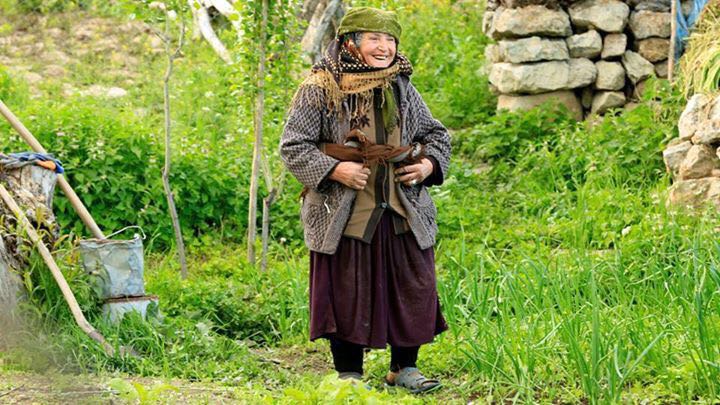
On the first Saturday of September 2016, in Qırızdəhnə — the lower of the two villages of the Qırız community, in the Quba mountains of northern Azerbaijan — I met a woman in her garden. She wore a green headscarf and a hand-woven belt, and she was laughing — at us, I think, kindly — the way you laugh at people who have driven a long way to see something you see every morning. We were told she was a hundred years old. Nobody in the village argued.
Prefer to listen? A reading — 54 seconds.
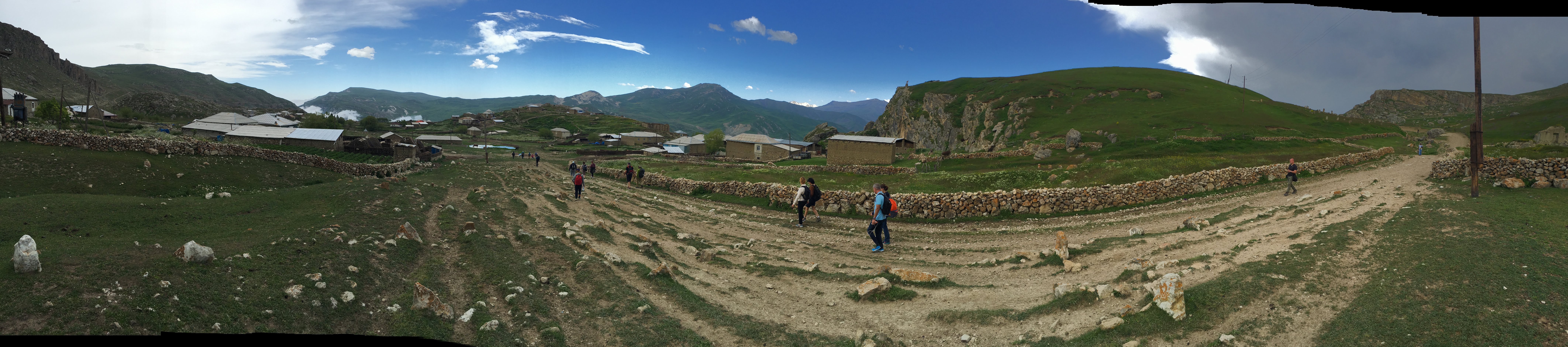
We had not come for her. We had come for a waterfall. That September I was walking with the hiking group of the Baku Khazar Rotary Club — a bus from the city, an experienced hiking guide, a landscape photographer along to teach anyone who wanted to learn, sandwiches made at home by club members. The village was where the bus stopped, and where the walk began and ended.
I have spent more than thirty years in an industry that certifies things — star ratings, audit scores, occupancy. So let me be honest the way this magazine has promised to be: I cannot certify her age. High villages keep thin paperwork, and the Caucasus has carried centenarian legends since long before anyone thought to sell yogurt with them. The number may be exact, or generous, or modest. What I can report is what I saw: a woman of very great age standing unassisted in a working garden, on a slope that tires visitors forty years younger, with a grip on her tools and a laugh that arrived from the whole body. Age is a number on a page. What she had is the thing the number is supposed to stand for.
The day, as it was planned
I still have the club's invitation. It is worth printing as it was, because it is the most honest description of a mountain day I own: no adjectives, only hours.
- 06:45 Meet at Nizami metro station, Baku
- 07:00 The bus leaves
- 10:00 Arrive in Qırızdəhnə; bags off the bus
- 10:15 Start the three-kilometre walk up to the waterfall
- 13:00 At the waterfall — photographs, and twenty to thirty minutes under the water for anyone who wanted it
- 13:30 Lunch
- 14:00 Climb toward the ridge, with the village and the waterfall below
- 16:00 Rest on the crest. Tea
- 17:00 Start down to the village
- 18:30 The bus leaves for Baku
- 20:00 A tea or meal stop on the road, thirty to forty-five minutes
- 22:00 Back in Baku
The terms were as plain: ten to twenty-five walkers, anyone from six years old who was well and could walk six to eight kilometres, fifty manat a head for the air-conditioned bus, the guide, a photo report of the day, fruit and biscuits and the homemade sandwiches. The kit list asked for waterproof boots or trainers, a few pairs of socks, comfortable clothes, something for the head, sun cream, a pack of thirty to forty litres, and one to two litres of water — preferably tea in a thermos. Even on a hiking list, in Azerbaijan, tea comes first.
Notice what the timetable admits without meaning to. The plan allowed nearly three hours for the first three kilometres: the gorge sets the pace, not the map. And the people who live there walk those slopes as part of an ordinary day, with no bus waiting at the bottom.
The honest detail. Fifteen hours door to door: about six of them on the bus, eight and a half in the mountains, breaks included. A day trip shows you the mountain; it does not lend you its structure. That is the case for staying — one night in a village guesthouse changes the arithmetic, and a week changes the body.
What the mountain actually provides
It is tempting to make the mountain mystical. The honest version is more useful, and in the end more beautiful: the mountain is a structure that makes the good choices the default ones.
Begin with the slope. In a high village, there is no flat errand. Water, firewood, a neighbour’s door, the garden terrace — everything sits above or below you, and so every ordinary day administers what a trainer would call a dose: load, incline, recovery, repeated for decades. The hill is a prescription nobody wrote. The research vocabulary calls this incidental activity and associates it, again and again, with the capacities that make old age livable — the legs, the balance, the breath. She did not have a program. She had terrain.
Then the table. Her vegetables grew an arm’s length from her kitchen; what the garden did not give, the animals and the season did. Not a philosophy of eating — a geography of it. Then the air and the rhythm: mountain settlements live closer to light and dark, to cold mornings and warm afternoons, than valley towns do — the body keeps an older calendar there. And then — perhaps most of all — the village itself. She was not alone. She had never, structurally, been alone. The path through her garden was a public one; people passed, called out, were answered. Readers of our essay on connection will recognise the claim: the research keeps finding that company is not a comfort added to health but a component of it.
The honest counterweight
Now the part a brochure would leave out. Mountains do not make people immortal, and hard places flatter their own statistics: a steep village keeps the hardy and sends the frail down to town, so the old people you meet at altitude are partly a selection, not only a result. Subsistence is not picturesque to the people living it. And one radiant woman in one garden is, by this magazine’s own rules, an anecdote — one test is noise, one meeting more so. We do not certify her century, and we do not promise you one.
What we claim is narrower and sturdier: the mountain reliably supplies the structure that the research keeps associating with capacity in later life — daily graded effort, food near its source, strong light rhythms, and unchosen, recurring company. Cities can simulate pieces of this with memberships and apps and calendars. The mountain simply charges no subscription and accepts no excuses.
What a journey borrows from her village
This is what a designed mountain journey is actually for — not to dress a visitor in costume, but to lend them the structure for a while and let the body remember. A walk that must be walked because the place demands it. A table set close to where the food grew. Wooden rooms that breathe, in the timber-and-stone grammar the highlands have always built in. Nights that get properly dark. Company at dinner that no one arranged in advance. A week of that is not her century — nothing is — but it is a fair sample of her ingredients, and a sample can be measured: the sleep before and after, the resting pulse, the stairs that stopped requiring negotiation. The mountain works, when it works, as a dose of an older way of being scheduled — and the change it makes is checkable.
Ten years have passed since that garden. I do not know how her story ended, and the honest sentence is that one. But I know what she gave a traveller who had arrived certified, audited, and tired: the clearest picture I have ever seen of what all the measurement is ultimately for. We measure what we can. Her laugh was not data. It was the thing the data is for.
Her photograph opens this first gathering of the magazine. It seemed right that the oldest argument should go first.
I carried a camera through those mountains in those years. The roads this essay walks — and the country that taught me them — are in this short film from my channel: Azerbaijan, Take Another Look.
Ahmet Can Yeşildağ spent more than thirty years in hospitality, across North America, the Caribbean, Europe, Asia and the Middle East & North Africa, before founding Orophile. He writes here on the design of restorative and longevity travel.
Weighing a trip like this? Start with a Free Introduction · 20 minutes. No obligation. → Or start with Eight Questions Before You Book.