The smell arrived before the mountain did. Sulphur, hot stone, something like a struck match left burning, and it was everywhere: in the car, in our clothes, in the bread we ate that night. The lava on the lower slopes was days old and still warm. Pines lay flat where the flow had pushed through them, their trunks pointing downhill as if the forest had been combed.
Provenance: Walked
We had come over from Malta by ferry. The ash had reached Malta first, settling on the island before we decided to go and see where it came from. That is the honest order of events: the volcano invited us, from about two hundred kilometres away, and we went.
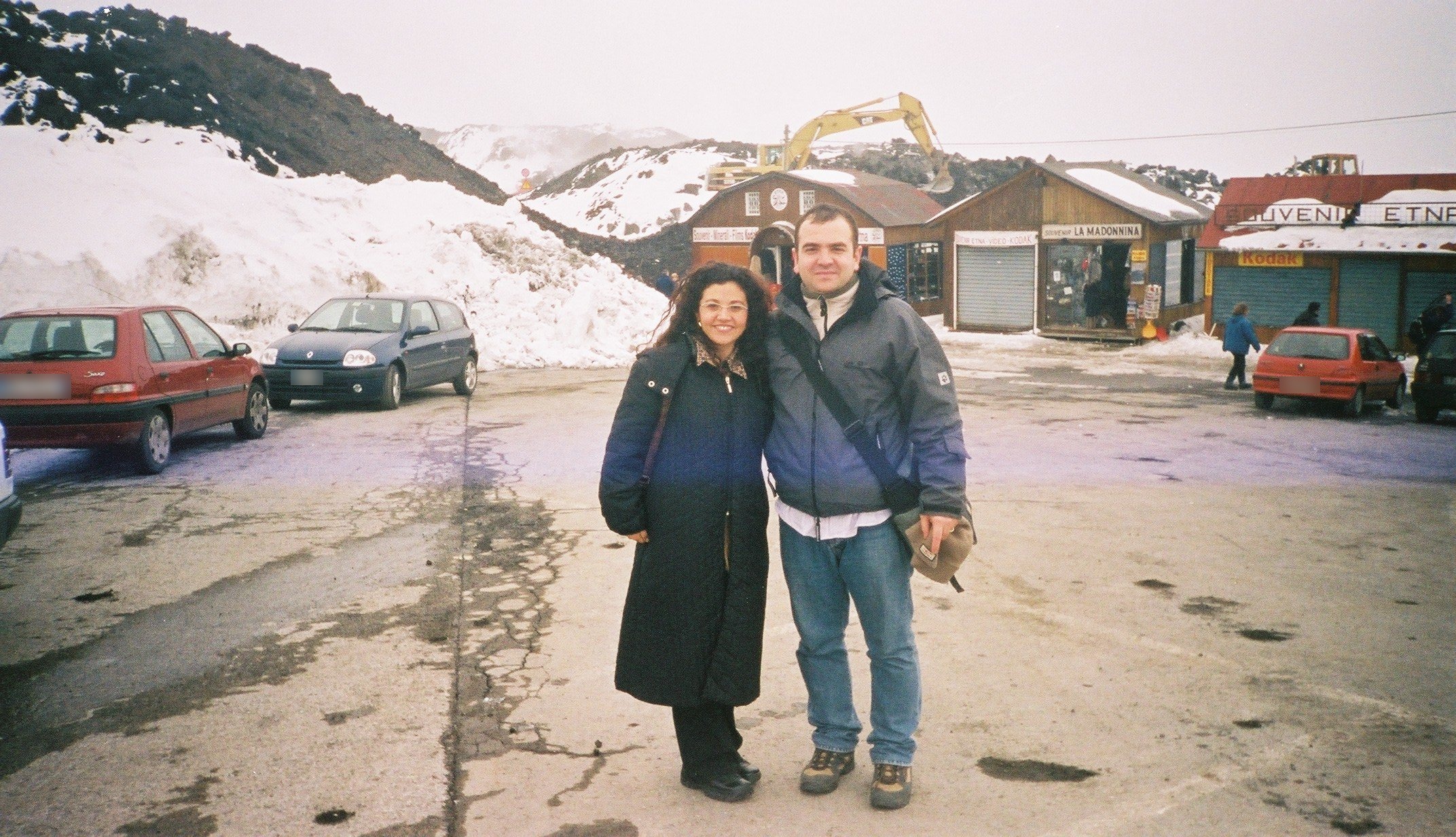
It was late 2002, by my best reckoning. I did not keep a diary and I was not a photographer, but two pictures survive from that day. In one, there is snow on the slope behind me, fog over everything, and a yellow digger at the edge of the frame, moving fresh lava off the track. In the other, the souvenir huts at the top of the road are open for business, Kodak signs and all, while another digger works on the lava bank behind them. Etna's large eruption of that period began on 26 October 2002 and ran until late January 2003. Within a day its ash had reached the Greek island of Kefalonia, and the University of Malta's own magazine records that the ash of 2001–2002 covered both of the main Maltese islands. On the first day, the lava destroyed the tourist station at Piano Provenzana on the north side and burned into the Ragabo pine forest. Trees like those are the ones I remember.
On the way down, farmers sold pistachios and other nuts at the roadside. Bronte, on the western flank, grows the pistachio Sicily calls green gold. The sellers recommended them, with straight faces, as an aphrodisiac. I bought a bag. I make no claims for it. I remember the colour, a green you do not see in supermarket pistachios, and the fact that the people selling them farmed on the side of a mountain that had just tried to bury their neighbours' trees.
It was an unbelievable view, an unbelievable smell and an unbelievable day. Twenty-four years later, this is what I would tell a guest planning the same trip.
What the numbers say
- Height: about 3,403 m, and it changes. That was the summit in September 2024. Each eruption builds or removes the top, so any printed figure is a snapshot.
- UNESCO World Heritage Site since 2013. The listed area is 19,237 hectares, the high, wild part of the mountain.
- Summer and autumn 2026 were active. Ash closed Catania airport at least three times between early August and late September. On 26 September the North-East Crater sent up a reddish-brown plume and the airport shut until midday the next day. On 29 September it closed again and reopened in under an hour.
- Summit access is guided only. Under the mayors' ordinances of 2021, tourists may go to about 2,750 m on the south side, a little higher on the north, and only with a qualified volcanological or alpine guide. When the risk level rises, those limits come down.
- Cable car: €54 return. The Funivia dell'Etna runs from Rifugio Sapienza at about 1,900 m to 2,500 m. Guided trips higher up, with a 4×4 transfer, cost more and vary by package (prices checked September 2026).
- Bronte pistachio: harvested every other year. It has had EU protected status (DOP) since 2009 and is picked in odd-numbered years, at the end of August and start of September, in Bronte, Adrano and Biancavilla. The 2026 festival in Bronte ran over two weekends and ended on 4 October.
How hospitality is organised
Etna works like two resorts and a farming district on one mountain. A hotelier reads it that way.
- The south side, Etna Sud. Rifugio Sapienza, the cable car, the coach park, the souvenir shops and the guides' cooperative. This is where most visitors go and where the mountain is easiest to reach from Catania. It is busy in summer and it is the place most likely to close when the volcano is active.
- The north side, Etna Nord. Piano Provenzana and the Linguaglossa side, quieter and wooded, with pine forest on the approach. This is the side the 2002 lava hit hardest. It is a better base for walking than for sightseeing.
- The farming flanks. Bronte for pistachios; vineyards on the north and east slopes; small towns where the restaurant is someone's family. Nothing here is organised for coaches. It is where a stay on Etna becomes a stay in Sicily rather than a visit to a viewpoint.
The quality is in the third layer. The first layer is for the crater, if the mountain allows it that week.
The Honest Detail
- The volcano sets the schedule. In 2026 ash closed the airport at least three times between August and late September. Build a spare day into any trip that depends on flying into Catania, or come by sea as we did.
- The summit is not guaranteed. Limits are set by ordinance and change with the risk level. A guide may turn the group back below the advertised height. That is the job, not a failure of service.
- The south side is crowded. Rifugio Sapienza in August is a car park with a volcano behind it. Go early, or base yourself on the north side.
- It is cold up there. At 2,500 m it can be near freezing in summer and there is snow from late autumn. The photographs from 2002 are the evidence.
- Cheap Bronte pistachio is rarely Bronte pistachio. The real product is expensive and comes from a small area. Buy from growers or from shops that show the DOP mark.
Who may not enjoy it: travellers who need a fixed plan, a guaranteed summit or a quiet viewpoint in August. Also anyone who wants Etna and the rest of Sicily inside three days.
Restorative Friction Index
Score 1 is low friction, 5 is high. These are editorial scores for three nights on the mountain with one guided day high up.
- Transfer load: 3. Catania is close, but ash closures make arrivals uncertain. The ferry from Malta takes about an hour and forty-five minutes to Pozzallo, then a long drive north.
- Schedule density: 2. One high day is enough. The rest is towns, food and slopes.
- Decision burden: 3. Check the activity bulletin, the ordinance and the guide's call on the morning itself.
- Physical demand: 3. The cable car does the climb. Walking on loose volcanic ground at altitude does the rest.
- Social intensity: 4 at Rifugio Sapienza in summer, 2 elsewhere. The crowds stay where the coaches stop.
One named voice
The reddish-brown plume was not new magma, but old material emptied from the crater's conduit. Marco Neri, volcanologist at INGV, on the ash of late September 2026 (as reported by La Sicilia and AeroCorner; our paraphrase)
That sentence is the mountain in brief. Not every plume is an eruption, and not every quiet week is safe. The people who live on Etna read it daily, the way a hotelier reads the morning occupancy report. A guest should borrow their habit: check, then go, then be ready to turn back.
What stayed with me was not the photographs. It was the smell, the combed pines and a bag of green nuts from a farmer who was not worried. The mountain had moved again and he was still selling. So were the souvenir huts.
The Mood Index: fifty places, sorted by what they do to you
Ayder, Read Honestly: another mountain, read for 2026
Ahmet Can Yeşildağ is the founder of Orophile Journeys and editor of Orophile Edit. His work connects a career in hospitality with considered travel advice.
Weighing a trip like this? A free 20-minute conversation, no obligation → Or start with Eight Questions Before You Book.
Orophile Edit is published alongside Orophile Journeys. No property or operator named here has paid for mention.