This week a large travel account put Capilano Suspension Bridge Park in front of a very large audience as a forest that "looks like something out of a fairytale." Seven frames: mist in the cedars, a cable bridge vanishing into green, a line of small figures crossing it in a hush. The caption ends with a question: would you visit it?
Provenance: Researched · sources named below
It is a fair question, and the honest answer is: yes, on the right terms. The photographs are not false. They are selective, and the selection is the part a traveller has to read.
What the numbers say
The bridge crosses the Capilano River canyon in North Vancouver. The park gives it as 137 metres long and about 70 metres above the river. The first crossing went up in 1889, built by George Grant Mackay, a Scottish civil engineer, with hemp rope and cedar planks; wire cable replaced the rope in 1903, and the bridge was rebuilt in 1956. The park has been privately owned and run since 1983 by Nancy Stibbard.
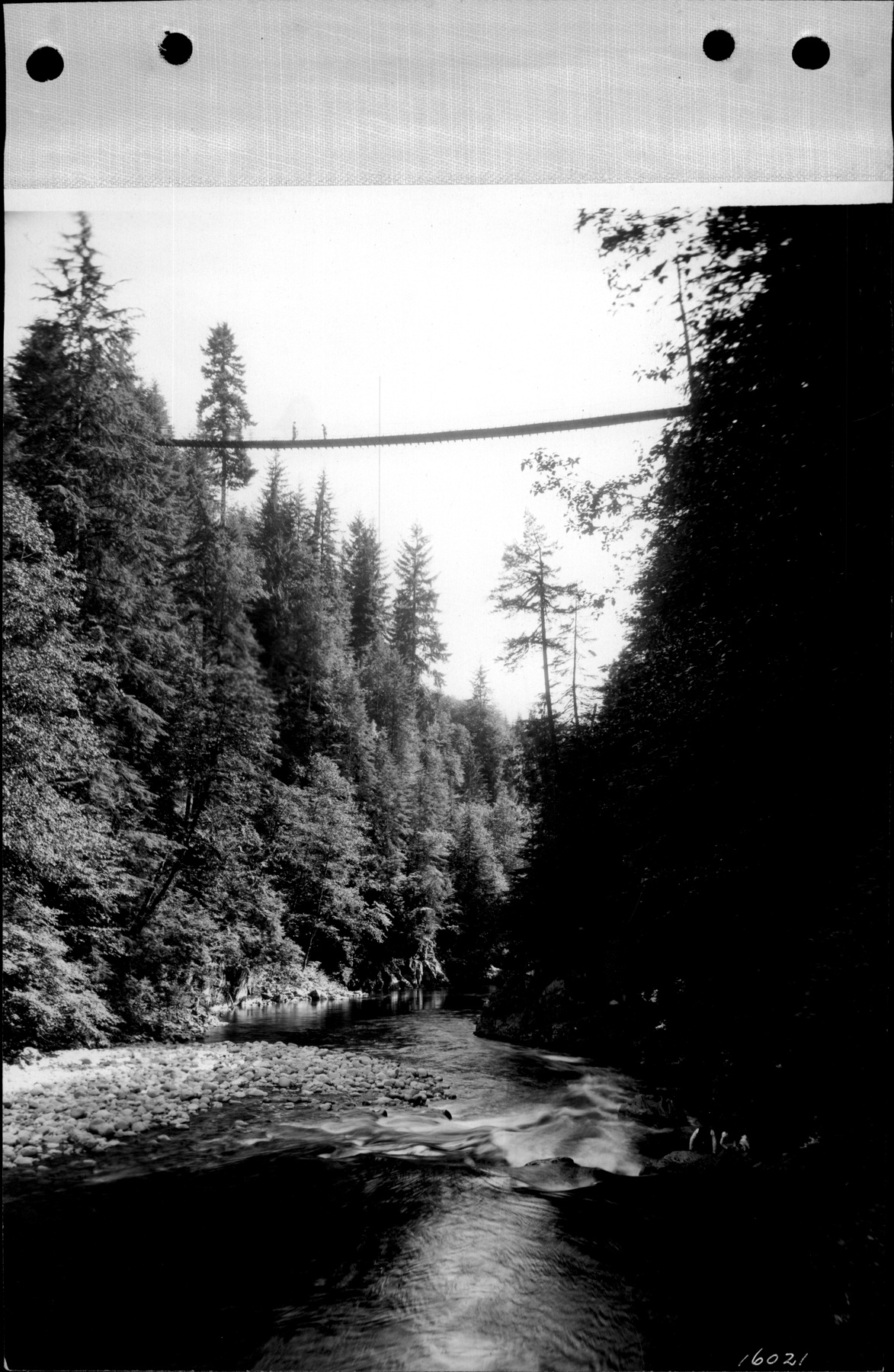
Two later additions are what most of the carousel actually shows. Treetops Adventure, opened in 2004, is seven footbridges strung between old Douglas firs on the west side of the canyon, up to 30 metres above the forest floor. Cliffwalk, opened in 2011, is 213 metres of narrow walkway, stairs and platforms bolted to the granite face, partly on open grating, as high as 30 storeys above the river.
And one number the photographs leave out: the park draws more than 1.2 million visitors a year.
The frame and the crowd
Every frame in that carousel is either empty or nearly so. That is a photographer's choice of hour, not the park's ordinary state. On a summer afternoon the bridge carries a steady line in both directions, it sways with every step of the people ahead of you, and the stillness in the pictures is replaced by conversation, phones and the sound of the river far below. None of that is a scandal. It is simply what 1.2 million visits a year feel like on a single span of cable.
This is the difference Orophile Edit keeps returning to: a description tells you what you will be asked to do; a promise tells you what you will feel. "Fairytale" is a promise. The park's own listing is closer to a description: a bridge, a canopy walk, a cliff walk, hours, a shuttle.
How the place is organised
Capilano is a ticketed private attraction, priced as one, and run with the efficiency of one: a free shuttle from downtown Vancouver, long opening hours, staff on the bridges, a gift shop, food, interpretation boards, and a seasonal programme that changes the park's character entirely. This autumn it runs Canyon Frights from 9 October to 1 November 2026; in winter the trees carry Canyon Lights. One ticket covers the bridge, Treetops and Cliffwalk for the day. The park currently offers a twilight rate, 25 per cent off admission after 5 p.m.
A hotelier reads that last line with interest. A twilight rate is how an operator moves demand away from the peak. It is also, for a guest who wants the photograph's version of the forest, the most useful sentence on the website.
The other bridge
Twenty minutes east, in the District of North Vancouver, Lynn Canyon Park has had its own suspension bridge since 1912. It is shorter and lower, about 50 metres above the water, and it has been free to cross since it became public. Around it are rainforest trails, Twin Falls and the 30 Foot Pool. It is less engineered, less interpreted and, on a weekday morning outside summer, often quieter. It has no canopy walk and no cliff walk. It also has no ticket desk.
Neither park is the "real" one. Capilano gives you more height, more structure and more help; Lynn Canyon gives you more room and asks more of your own judgment, including near the water, where the pools are cold and the rock is slick.
The Honest Detail
- Best hours: the first hour after opening, or the twilight window, on a weekday. Shoulder months (April–May, September–October) are kinder than July and August.
- Who may not enjoy it: anyone uneasy with height and movement. The main bridge sways; Cliffwalk has open grating underfoot. Treetops is the gentlest of the three.
- Rain: this is a coastal rainforest. Mist is what makes the photographs; it also makes the planks wet. Wear shoes that grip.
- Time: two to three unhurried hours covers all three walks. Rushing it defeats the purpose.
- Cost: check the park's current rates before you go; they change by season and the twilight rate is worth planning around.
Restorative Friction, read plainly
Transfer load: low — free shuttle from downtown, or a short drive. Schedule density: low, if you choose the hour well. Decision burden: low; the route is laid out for you. Physical demand: low to moderate; stairs on Cliffwalk, steady walking throughout. Social intensity: the variable that decides the visit — high at midday in summer, low at opening or dusk in the shoulder season.
What it asks of you
Go for the trees, not the picture of the trees. The Douglas firs and cedars that hold up Treetops were there long before the walkways, and they are the reason the place feels the way the carousel says it does. Give them the quiet hour. Walk the canopy slowly, stop on a platform until the people behind you have passed, and let the river do the talking from 70 metres down. If you want the forest without the turnstile, go to Lynn Canyon on a weekday and walk on to Twin Falls.
The fairytale is available. It is just not available at two in the afternoon in August.
Weighing a trip like this? A free 20-minute conversation, no obligation → Or start with Eight Questions Before You Book.
Sources. Capilano Suspension Bridge Park, official site (capbridge.com): bridge and Cliffwalk specifications, opening hours, free shuttle, twilight rate, Canyon Frights dates, read 6 October 2026. Wikipedia, "Capilano Suspension Bridge": 1889 construction by George Grant Mackay, 1903 cable, 1956 rebuild, ownership since 1983, annual visitors, Treetops Adventure (2004). Wikipedia, "Lynn Canyon Suspension Bridge" and lynncanyon.ca: 1912 opening, height, free crossing. Archive photograph: Ingenium – Canada's Museums of Science and Innovation, CN Images of Canada Collection, item 16021, public domain in Canada. The carousel that prompted this piece was published by @earthpix with photography credited to @princerphoto and @bucketlistworldtravel; its images are theirs and are not reproduced here. This piece is labelled Researched: the figures and the park's current offer were read from the named sources, not from a recent visit.