Walked · Japan, 2002
I went to Japan in 2002 with two hundred people.
Not as a traveller. I took a delegation to the 85th Lions Clubs International Convention in Osaka, and I was the one responsible for their rooms, their transfers and their meals. I saw Japanese hospitality from both seats at once: the buyer ordering it in bulk, and the guest being served by it. I have not been back.
What follows is that year, in five parts, set beside what the numbers say the country has become. At the end I tell you how the edition was made, and what it does not know.
Part of the programme was held on a film-studio backlot. The meetings were there, and so was a parade — two hundred people from Türkiye walking down a street built to look like New York, inside a Japanese studio park. Nobody thought the street was in New York. That was not the point, and no one was deceived. It was a good venue, well run, and it worked.
I have been thinking about that parade for a while, because of what has happened since. It was honest about being a set. Since then I have watched a county in Yunnan renamed after an English novel to make it sellable, a lane in Kyoto circulate online labelled as Tokyo, and a landscape in Kyrgyzstan advertised with pictures the platform itself marks as machine-generated. The set is still being built. What has gone is the part where everyone knew it was a set.
In April 2003 — the year after I was there — Japan's transport and tourism ministry launched the Visit Japan Campaign. The country was receiving about five million foreign visitors a year, and the aim was to double that by 2010. In 2024 it received 36.87 million, who spent ¥8.14 trillion.
So the Japan I walked is the last one before that decision. I am not going to tell you what the country is like now; I was not there for it. I am going to tell you what it was like the year before the campaign, and let the numbers carry the rest.
When you buy hospitality for two hundred people you stop seeing the front desk and start seeing the system behind it: how a hotel turns two hundred rooms in one afternoon, how a coach schedule holds when one group is late, how a kitchen feeds a delegation at one sitting without the last table eating cold. In Osaka every one of those held. I did not have to chase anything. In thirty years of operating hotels I can count the cities where that was true.
That is the operator's read. The guest's read was quieter: the room was ready, the meal was on time, and nobody performed the service at me. It was simply done.
Japan will show you the set with a straight face, and it will also show you the place the set was copied from, often on the same street. The work is telling them apart, and deciding which one you came for. A studio backlot is a fine afternoon if you know it is a backlot. A temple step at seven in the morning is a different afternoon altogether.
If you want to plan that difference with someone who has bought the country in bulk and walked it on foot, the first conversation is free and it is a conversation, not a booking.
Japan named its own landscape practice before it sold it. In 1982 the Forestry Agency coined shinrin-yoku — forest bathing — under its then director, Tomohide Akiyama, and put a word on something the country's households had been doing for centuries without one. The world bought the word. The practice underneath it is still real; the evidence for it, on blood pressure and cortisol, is moderate and I have written about its limits elsewhere in this journal.
Set that beside Yunnan, which renamed a county to sell it and hollowed it out. Both were packaging. Only one survived it. What made the difference is what this edition is trying to work out, and I would rather work it out in front of you than announce it.
How this edition was made. From here on, every edition of Orophile Edit carries one of three words at the top. Walked means I was there. Reported means I was not, and the people who were are named and quoted. Researched means neither, and the sources are listed. This one says Walked, and it also says 2002 — because a label that never admits its own age is not a label.
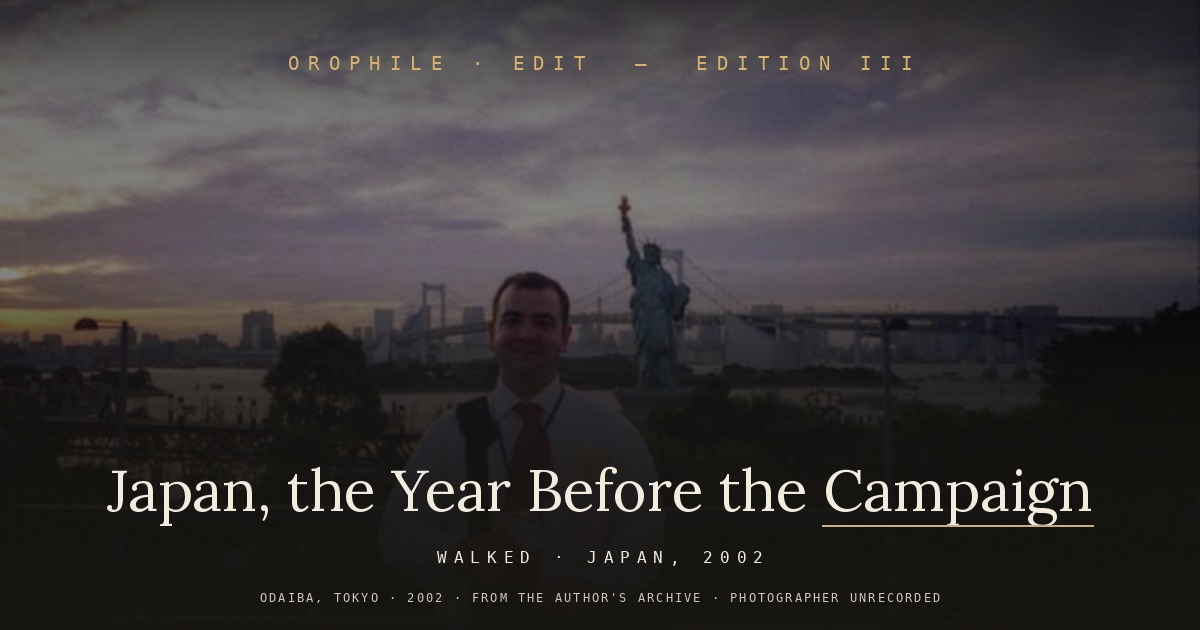
The photographs from that trip exist as prints — Odaiba, the studio backlot, a Shinkansen platform, Kiyomizu-zaka, a temple step at seven in the morning. They are being scanned and will be added here with the place and the year under each, and where I do not know who held the camera it will say so. Until then the only photograph here is the cover — Odaiba, from a copy of the print — and the edition says so rather than borrowing someone else's Japan.
Sources for what I did not see myself. The Visit Japan Campaign's launch and its five-to-ten-million target: The Japan Times, 24 April 2003. The 2024 arrivals and spending: JITTI USA, on the Japan National Tourism Organization's 2024 figures. The 1982 coining of shinrin-yoku: Forest History Society, "From Haiku to Shinrin-yoku".
— Ahmet Can Yeşildağ, Editor
Oakville, Ontario · September 2026
Owed, and not forgotten. Editions I and II promised an October issue under the theme Descent, carrying the longer Eastern Townships essay and the first of the thermal Anatolia essays. This is not that issue. It arrived earlier and from further away, and it is called what it is. The theme and the two essays are not dropped; they are carried to the first edition that can hold them honestly, and I will say which one when I know.
— ACY