Travel Journal Editions / Mountains Without Borders
Edited by Ahmet Can Yeşildağ. A researched reading of mountain landscapes and cultures.
The Alpine–Himalayan belt is a broad zone of related mountain-building histories across the Mediterranean and southern Eurasia. It includes different collision and subduction systems, not one continuous ridge formed in a single event.
The Dolomites preserve Triassic marine carbonate platforms in the Italian Alps. Aladağlar is a limestone-dominated part of Türkiye’s Taurus system. The Kaçkar Mountains include intrusive and volcanic rocks, glacial valleys and high pastures. Each range has distinct local climates and communities.
A yayla is a highland pasture or settlement associated with seasonal use. In mountain communities, yayla life can involve livestock, household work and movement between elevations. Tourism has changed some settlements, but practices vary by place and community.
Anthropology examines how people organise livelihoods, belonging, land use and hospitality. In this edition, regional studies help explain seasonal movement, language and identity, and the labour behind tourism and mountaineering.
Explore this edition: Dolomites · Taurus · Kaçkar · Regional atlas · Anthropology · Books and research
Researched · Mountain landscapes, cultures and the Alpine–Himalayan world · Revised 28 September 2026
The mountains do not share a language. They give us a reason to listen.
The pale walls of the Dolomites, the high country of the Taurus and the glacial valleys of the Kaçkar Mountains invite comparison. They also resist it. A photograph can make two ranges look related while concealing almost everything that matters to the person arriving: the weather, the rock, the water, the language spoken at the table and the work required to keep a house open above the valley.
This revised Edition I begins with three mountain landscapes, then widens into a west-to-east atlas and an anthropological reading of mountain life. The Dolomites are the starting point. Aladağlar provides a focused window into the much larger Taurus range. The Kaçkar Mountains bring the eastern Black Sea into the conversation. The theme of Approach remains: how to enter a place with enough attention to see more than its outline.
The Alpine–Himalayan mountain belt is a broad tectonic framework, not one unbroken ridge or a single event. Its regional histories involve different rocks, basins, movements and stages of uplift. Placing these landscapes within that wider story does not make them geological copies. The Pontides, the northern mountain belt of Türkiye that includes the eastern Black Sea ranges, are discussed within this framework in the MTA geological literature.
Read the geography at two scales: first the long history of mountain building, then the individual valley. The first gives context; the second determines the journey. No line across a continent can tell a walker where there will be water, shelter or a safe passage.
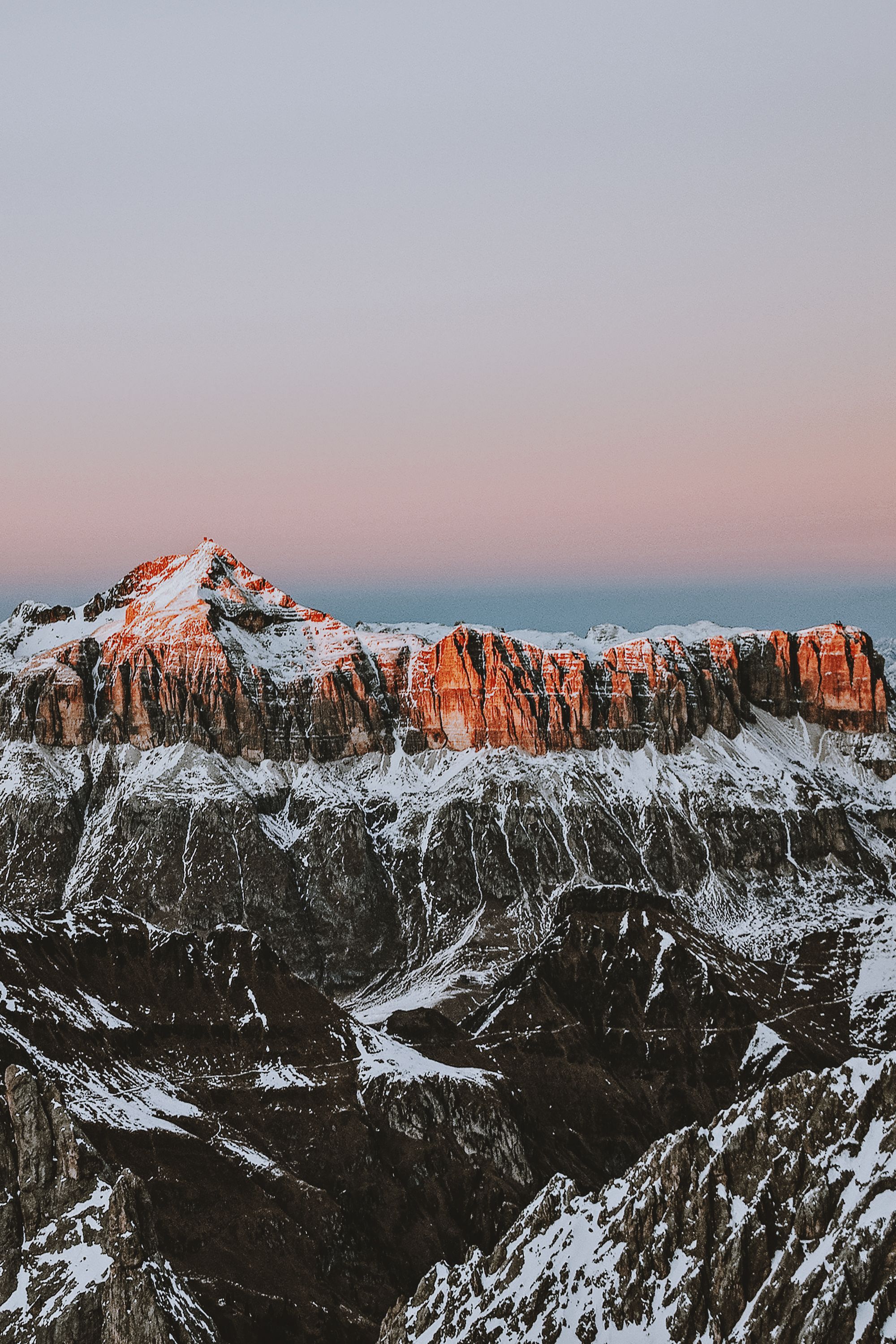
In the northern Italian Alps, Triassic marine carbonate platforms and reef systems survive as exposed geological records. UNESCO recognises the Dolomites for both their exceptional landscape and the evidence they preserve of those former environments. To describe the entire range simply as fossilised coral would miss the variety of its rocks and the history written between them.
The visual attraction is immediate: steep pale faces above valleys and pastures. The more rewarding question is slower. What was here before this was a mountain? A visitor who begins with that question looks at a rock wall differently. It becomes evidence as well as scenery.
The human landscape deserves the same attention. Ladin language and cultural history belong to the living identity of the Dolomites. A museum visit, a place name and a conversation about a valley can be as important to understanding the journey as the view from above it.
Aladağlar is part of the central Taurus. It is the comparison used here, not a substitute for every landscape across the Taurus system. Its high rocky terrain can suggest austerity, but the national park also contains forested valleys and substantial plant diversity. The Hacer Valley is a useful correction to any description that turns the whole range into a desert.
A mountain itinerary should make its practical arrangements visible. Where does the walking day end? What must be carried? Which services have actually been arranged? A sparse-looking landscape should not become an excuse for vague logistics, nor should a comfortable base erase the demands of the route above it.
The editorial interest is the relationship between the high country and the settlements that support a visit. The people providing transport, meals, guiding and accommodation belong inside the story. They are not merely the background to someone else's summit.
The Kaçkar Mountains contain granite and related intrusive rocks as well as volcanic rocks. Türkiye's regional tourism authorities describe a landscape shaped strongly by rivers and glaciers. Glacial lakes, high meadows and forested approaches contribute to a very different visual character from the pale walls that introduce this edition.
The range should not be reduced to one weather description. Aspect, altitude and the chosen valley matter. The official description of the southern approach through Yaylalar, for example, places forests and meadows within the mountain journey. A named route and a local assessment are more useful than a general promise of green scenery.
The word yayla also asks for care. A high pasture is a lived landscape, not an empty stage for visitors. The traveller's task is to learn how to be present without treating ordinary life as a performance arranged for the camera.
A mountain hut, a village guesthouse and a hotel in the valley offer different relationships with a place. The UNESCO Dolomites Foundation describes refuges as places of hospitality and encounter, with a role in protecting local territory and culture. That is a more useful starting point than assuming every rifugio delivers hotel-standard comfort.
For Orophile, the questions are concrete. Who prepares the meal? What kind of room is being offered? How are water and waste handled? What happens when the weather interrupts the plan? A good host explains the limits as clearly as the welcome.
Comfort can support a thoughtful journey. It should be described precisely: a private room, reliable transfers, a shorter walking day or time at a shared table. None of those needs to be sold as a medical intervention. Rest and curiosity are sufficient reasons to travel.
For landscape and culture: build the visit around a settled base, local interpretation and outings matched to the traveller. Leave space for a museum, a meal and a day when the mountain remains behind cloud.
For walking: distinguish a valley walk from a high traverse. Confirm current conditions, accommodation arrangements and the demands of each day with a qualified local provider before committing.
For climbing: name the activity honestly. Via ferrata is a protected climbing route, not simply a scenic footpath. The UIAA specifies equipment including a helmet, harness and appropriate ferrata kit, together with the knowledge to use it. Glacier travel and technical rock routes likewise belong to a different planning conversation from a gentle mountain holiday.
The question is not which range wins. It is which kind of encounter you are prepared to make time for. Geology can begin the conversation; the way you travel determines whether it continues.
The three landscapes above are our points of entry into a much larger story. The following west-to-east reading follows mountain systems often discussed within, or alongside, the Alpine–Himalayan framework. It is an orientation through connected geological histories, not a continuous walking itinerary. Mountain building includes the closing of ocean basins, continental collision, subduction, faulting and the reactivation of older structures. These processes did not happen everywhere at the same time.
Why do these places matter beyond their silhouettes? They hold habitats, influence water supplies and weather, and sustain communities whose lives extend far beyond tourism. Geographer Martin Price’s Mountains: A Very Short Introduction provides an accessible introduction to these environmental and social connections. Keep that wider frame in mind: a summit is one part of a mountain system, not its entire value.
North Africa introduces an essential distinction. The Atlas and the Rif belong in a regional account of Africa–Eurasia convergence, but they are not interchangeable. Research distinguishes the intraplate Atlas from the Rif at the plate-boundary zone; their deep structures and uplift histories differ. Across the Strait of Gibraltar, the Rif is closely connected to the Betic system of southern Spain. See the Atlas–Rif geophysical study and Betic tectonic overview.
Their importance is also ecological and practical. UNESCO’s Atlas Cedar biosphere account identifies mountain ecosystems and water resources that matter to the surrounding region. This shifts the visitor’s attention from a high skyline to forests, catchments and the people who depend on them. An account of the Atlas should ask how access to land and water is organised, rather than treating a village as a picturesque accessory.
The Betic ranges, including Sierra Nevada in southern Spain, and the Pyrenees along the northern edge of Iberia occupy different positions in the western Mediterranean story. Their relationship to plate movement cannot be reduced to a single eastward continuation. The research on the Betic–Rif system places them within a history of changing basins, shortening and motion between Iberia and Africa.
In the Pyrenees, UNESCO’s Mont Perdu account connects limestone landforms with villages, paths, meadows and seasonal livestock movement. That combination explains why the mountains matter culturally: the landscape includes work repeated across generations. A path may have been a connection between grazing grounds before it became a recreational route. The history of its use deserves as much attention as its gradient.
The Alps provide the larger setting for the Dolomites, but one Italian range cannot stand for every Alpine valley. UNESCO’s Dolomites inscription identifies the exceptional record of Triassic carbonate platforms as well as the dramatic scenery. The scientific value lies in what the exposed formations reveal about former marine environments; their present elevation belongs to a later chapter of mountain building.
The cultural question is equally specific. John W. Cole and Eric R. Wolf’s The Hidden Frontier compares St. Felix and Tret, neighbouring Alpine villages with different linguistic histories. Their study concerns those communities, not every Ladin valley. It offers a useful reason to resist environmental determinism: sharing a mountain setting does not mean sharing an identical social history. For this edition, the interpretive task is to look for language, institutions and historical boundaries alongside rock and relief.
The Apennines broaden the Italian story beyond the Alps. Their significance is not dependent on competing with Alpine summit heights. The Appennino Tosco-Emiliano biosphere reserve provides a northern example of mountain biodiversity and the relationship between environmental protection and inhabited territory. A country’s mountain interior can be central to its identity even when coastal cities dominate its visitor imagery.
Fernand Braudel’s The Mediterranean, Volume I, opens its environmental history with mountains, plateaux and plains and includes transhumance. This is historical reading, not a description of present-day Italy. It supplies a productive question for travel writing: how have movement between elevations, access to routes and the demands of making a living connected uplands to the wider Mediterranean?
The Carpathians turn the eye from isolated peaks toward a broad mountain arc and its habitats. UNESCO’s transnational beech-forest inscription traces the expansion of European beech from refuges after the last Ice Age, including refuges in the Carpathians and other European ranges. A forest is therefore a historical landscape as well as a present-day habitat.
At Djerdap Geopark, the Danube’s passage through the Southern Carpathian region brings geology into conversation with archaeology and human settlement. This gives the range a second importance: mountains channel movement without preventing it entirely. Rivers and passages help explain why a mountain boundary can also become a place of contact.
The Dinaric landscape is especially instructive where water moves through soluble rock. Karst includes caves, springs and underground drainage, so the visible river tells only part of the story. UNESCO’s Tara River Basin account describes gorges, glacial lakes and karst springs; Vjetrenica Cave adds the importance of subterranean biodiversity. Protection must extend below the surface that visitors see.
Farther southeast, the Pindus deserves its own geological identity. The Northern Pindos National Park geology account describes ophiolitic rocks as well as other formations, while Vikos–Aoos Geopark explains the region’s geological development and water-shaped relief. These are valuable places to understand that a mountain landscape can preserve evidence of former oceanic environments without consisting entirely of limestone.
Northern Türkiye’s Pontic mountain geography includes ranges known as Küre, Ilgaz, Canik, Giresun and Kaçkar. These regional names help orient the reader; they should not be mistaken for a claim that every massif has the same rock history. The Taurus forms a different southern system, within which Beydağları, Bolkar and Aladağlar provide distinct settings. Our Aladağlar account is deliberately local, rather than a description of all the Taurus.
The larger tectonic setting involves the interactions of Africa, Arabia, Eurasia and Anatolia. The USGS regional synthesis describes several processes, including collision, subduction and sideways motion along faults. A neat line drawn across a map hides this complexity.
The Greater and Lesser Caucasus also require separate regional attention. In the western Greater Caucasus, UNESCO’s Western Caucasus property highlights extensive mountain habitats and relatively undisturbed forests. Its conservation importance is a reason to see beyond summit prestige. No single ecological description or ethnographic portrait can adequately represent all communities between the Black and Caspian seas.
The Zagros is a major fold-and-thrust system produced by Arabia–Eurasia convergence, extending through western Iran into northeastern Iraq. Here geological compression helps explain the repeated ridges visible at regional scale. The USGS Middle East account provides the tectonic context; it does not make every valley culturally or environmentally equivalent.
Alborz, also written Elburz, is the northern Iranian mountain system; the name should not be confused with Mount Elbrus in the Caucasus. Along the southern Caspian region, the Hyrcanian forests demonstrate a wooded ecological history that contradicts any image of Iran as uniformly arid. Farther east, Kopet Dag’s biosphere reserve lies along the Iran–Turkmenistan border and includes mountain woodland. The significance of these ranges is the variety of environments they hold, not just their place on a continental diagram.
The Hindu Kush and Pamir belong to the broad deformation associated with India’s convergence with Eurasia. Tajik National Park gives a view of the Pamir’s high terrain, glaciers and wildlife. The familiar image of a mountain knot is a useful orientation, but the Pamir and Hindu Kush remain distinct places rather than interchangeable names for high Asia.
The Tien Shan, or Tanrı Dağları, needs an explicit qualification. It is an older mountain system reactivated within the continent; the USGS Himalayan regional account relates its present deformation to the far-reaching effects of India–Eurasia collision. It should not be presented as simply another newly formed segment of the Himalayan ridge. Western Tien-Shan’s UNESCO account also foregrounds biodiversity, reminding us that the range’s significance extends well beyond its tectonic classification.
The Karakoram, the Himalaya and the Tibetan Plateau are connected within the India–Asia collision story, but a mountain range and an elevated plateau are different geographical forms. Geologist Mike Searle’s Colliding Continents is a substantial reading companion to their geological development, combining an explanation of the region with his own fieldwork history. The book’s firsthand voice belongs to its author; this edition does not claim those expeditions as its own.
Their wider importance becomes clearer when we follow water downhill. Christopher A. Scott and colleagues’ “Water in the Hindu Kush Himalaya” explains the unequal contributions of rain, snow and glacier melt across different basins. “Asia’s water tower” is useful shorthand only if we retain that variation. The Indus and a monsoon-dominated basin cannot be treated as identical plumbing systems.
The Hindu Kush Himalaya Assessment joins environmental research to livelihoods and development. Its relevance is that changes high in the mountains concern people who may never climb them. At the scale of a particular place, Sagarmatha National Park also brings Sherpa culture into the account of a celebrated Himalayan landscape. The region is inhabited and socially complex, not empty altitude.
In western Myanmar, the Arakan Yoma, also called the Rakhine Mountains, forms part of the Indo-Burman ranges. Research on the development of the Indo-Burman ranges describes an accretionary-prism history and episodes of uplift. An accretionary prism is built from material gathered and deformed near a subduction boundary: a different emphasis from simply imagining two continents pushing up one continuous wall.
Southward, the Andaman–Nicobar region belongs to a complex subduction setting. The USGS account of the Sunda trench makes the offshore tectonic connection visible. The islands are not merely the exposed tops of an uncomplicated extension of the Himalaya.
The Sunda system continues through the Indonesian region, where subduction and volcanism become essential to the account. Bukit Barisan specifically names Sumatra’s mountain spine; it is not a collective name for all mountains of Sumatra and Java. UNESCO’s Tropical Rainforest Heritage of Sumatra identifies the conservation importance of lowland and mountain forests. At this eastern end of our reading, the story has changed from pale cliffs and alpine meadows to tropical habitats and an active plate margin.
Geology explains how the ground acquired its form. Anthropology asks how people live with that ground, give it meaning, organise access to it and respond when outsiders arrive. Neither discipline replaces the other. A mountain pasture can be a habitat, a workplace, an inherited obligation and a visitor’s photograph at the same time. The following studies offer situated examples, not a universal portrait of “mountain people”.
Transhumance means recurrent seasonal movement between grazing areas; it should not be used as a synonym for every form of nomadic life. At Mont Perdu, UNESCO documents villages and trails connected with seasonal livestock movement. In Anatolia, Mustafa Genç and Seda Şimşek Tolacı’s 2019 study of Sarıkeçili Yörüks in Atabey and Gönen uses observations and interviews to examine social practices and the spaces in which they take place. The authors record both continuity and change. Their particular study cannot stand for all Yörük communities or every Taurus valley.
An anthropological account should therefore ask who can use a pasture, who performs the work, and what happens when roads, schooling, markets or land-use rules alter a household’s choices. These are questions for local investigation, not answers that can be inferred from a tent or a traditional-looking house. Mobility need not signify the absence of a home; it may be part of how a home and livelihood are maintained.
Ali Fuat Doğu, Mehmet Somuncu, İhsan Çiçek, Harun Tunçel and Gürcan Gürgen’s 1993 study of Kaçkar glacial landforms, yaylas and tourism connects the location of highland settlements with glacial valleys and differences in snowmelt across elevations. It is a valuable meeting point between physical and human geography. Its historical descriptions of glaciers must not be treated as measurements of their present extent.
Serkan Doğanay’s 2010 research around Çakırgöl examines a shift from livestock-oriented yayla activity toward recreational uses and the pressures accompanying tourism. Çakırgöl is in the Kalkanlı Mountains, not the Kaçkar massif; the comparison is regional, not evidence that every Kaçkar settlement has followed the same trajectory. Together, these studies suggest a better question than whether a village remains “unchanged”: who benefits from change, who decides its direction, and which everyday practices become harder to sustain?
Cole and Wolf’s The Hidden Frontier: Ecology and Ethnicity in an Alpine Valley examines neighbouring St. Felix and Tret through ecology, language and political history. Michael E. Meeker’s A Nation of Empire brings ethnography and archives together in the eastern Black Sea, with particular attention to Of and the history of local power. These works concern different regions and problems. Reading them alongside one another is our editorial comparison, not a claim that the authors proposed a shared model of Alpine and Anatolian society.
The comparison helps frame a discipline of attention. Place names, language, institutions and a community’s relationship with the state belong in a mountain narrative. A valley should not be declared isolated simply because the road into it is steep. Equally, a single label should not erase differences between neighbouring communities or between people within the same settlement.
In Life and Death on Mt. Everest: Sherpas and Himalayan Mountaineering, anthropologist Sherry B. Ortner examines the historically changing relationship between Sherpas and visiting mountaineers. Her account brings employment, dependence, cultural interpretation and risk into the story of Himalayan climbing. It gives us a reason to ask who performs the work behind an expedition’s public achievement. “Sherpa” names a people and should not be used indiscriminately for anyone carrying a load.
Our editorial implication is practical: name local expertise and acknowledge the labour that makes a journey possible. A guide, cook, porter or host is a person with skills and decisions of their own. Questions about payment, responsibility and who carries risk belong beside questions about scenery. This perspective also travels usefully to a rifugio or yayla guesthouse, without assuming that their working arrangements are identical to an Everest expedition.
Robert Macfarlane’s Mountains of the Mind examines the cultural fascination with mountains. It is literary and historical reading, not a geological handbook or a substitute for local ethnography. Placed beside Ortner’s work, it invites an editorial question: when a visitor seeks solitude, challenge or transformation, whose daily work makes that experience possible?
Orophile’s approach is to keep that question visible. Hospitality can be studied through meals, welcome, privacy, household work and the negotiation of expectations. None of those should be assumed to mean the same thing everywhere. Future firsthand reporting would require conversations with residents, attention to consent, and room for accounts that disagree with the visitor’s preferred story.
The books below serve different purposes: geological explanation, environmental synthesis, historical interpretation and ethnography. Bibliographic details and scope were checked against publisher or institutional records. Unless an accessible chapter or article is identified, these are contextual reading references, not claims to have reviewed the entire book. No unverified quotations or page-specific claims are used.
For regional planning context, read our Dolomites guide, Türkiye guide, Georgia and Caucasus guide, Pyrenees guide and Himalaya guide. For questions to take into a planning conversation, use the eight-question restorative travel checklist.
This is a researched editorial comparison, not a claim of firsthand visits, interviews or current route inspection. Its interpretations of hospitality and the comparisons between regional studies are editorial perspectives. The anthropology section is a reading of published research, not new ethnographic fieldwork. It does not certify accommodation, prescribe a trekking route or promise health outcomes. Seasonal access and operating details must be checked separately when planning travel.
Sources checked for this revision:
For a personal discussion about the pace and character of a mountain journey, visit Orophile Journeys. Travel advisory services are separate from this editorial comparison.
Publication history. Edition I originally appeared under the title Approach. On 28 September 2026 its main editorial focus was revised to Mountains Without Borders. The original introduction is retained below as a historical record; its future-edition announcements refer to the time of original publication. The linked essays and field notes following this archive are the original Greece and Quebec selection, not reports from the three mountain regions above.
A publication should know what it is for. Orophile Edit is for readers who travel slowly, who return, and who notice the difference the landscape makes to the people who visit it.
The essays here are written from a single editor's perspective — a working hospitality practitioner with more than thirty years of hospitality experience who has spent the past two years watching what happens when high-performing people stop performing for a while. Some of them recover. Some merely pause. A small number return to their lives with the kind of quiet recalibration that takes years to undo. The publication is for the people in that third group, and for the people who are trying to find their way into it.
The pieces in this first Edition are written under the working theme Approach. The word does three things at once: it names the literal arrival — the road in, the descent into a valley, the first sight of the place — and it names the editorial posture by which I will be writing here, which is one of slow approach rather than declaration. It also names a practitioner's approach: how one comes back to a landscape that has been left for a while, what changes in the body and in the attention during the first three days.
Edition I carries two essays and two field notes. The first essay, The Road Through Mystras, opens in the Peloponnese, on the long drive over the Taygetos pass from Kalamata to Sparta. It describes three days inside the ruined Byzantine fortress town of Mystras and one morning on the descent road south toward the Mani. The second essay, Three Mornings in Pelion, sits in the village of Tsagarada on the eastern flank of the Pelion peninsula in central Greece, and is organised around three consecutive dawn walks under an old plane tree.
The two field notes — Notes from the Mani at Dusk and A Morning at Lake Massawippi — are shorter. The first observes a southern Peloponnese village at the hour the light goes flat. The second sits on a Quebec dock at five-fifty in late June, listening to two loons exchange their phrases across a lake that still remembers the ice that made it.
The geographic centre of this first Edition is the Mediterranean mountain-shore region — the Peloponnese, Pelion, and adjacent ranges where slow Greek inland travel runs against the rhythm of the typical Aegean-coast visit. The publication will, over time, range much more widely. The first Edition is set close to a single editorial preoccupation in order to establish the voice. Subsequent Editions will travel north, west, east, and inland to the ranges of Anatolia, Iberia, the North Atlantic islands, the Eastern Townships of Quebec, and the Algonquin range of Ontario.
Future Editions will follow the seasons. Edition II, in August, will run under the theme Return. Edition III, in October, will run under the theme Descent, when autumn arrives in the northern landscapes and the editorial register begins to slow toward winter.
There is no schedule to which a reader needs to keep pace. The publication's archive will hold every piece indefinitely. A reader who arrives in 2034 to read this first Edition will find it where it was, with the same images, the same captions, the same plane tree under which a third morning began to dissolve.
I am grateful, on this first day, to the readers who are arriving here at the beginning.
— Ahmet Can Yeşildağ, Editor
Oakville, Ontario · July 2026
Looking ahead. Edition II arrives at the beginning of August. The working theme is Return. The Edition will sit in two landscapes a reader of this first issue will not yet know I was preparing for: the inland ranges of Anatolia, where I was born and to which I have not returned in twenty years, and the upper lakes of the Eastern Townships, which a long-term reader will already have seen me approach in A Morning at Lake Massawippi but which are due a longer essay. Until August, the writing here is in the keeping of readers who came for the slow paragraphs and the long approach.
— ACY